The music world lost one of its most visionary producers and sonic architects when the family of William Orbit (born William Mark Wainwright) announced his passing at the age of 69 last week. Though Orbit passed away at his home in London on July 23, 2026, the news was formally shared on August 7, sending a wave of reflection, gratitude, and grief through the global music community.
Orbit was never simply a producer who made records sound expensive or polished; he was a painter of sound waves who altered the very air around his compositions. Long before electronic dance music became a fixture of mainstream radio, William Orbit demonstrated that synthesisers, ambient tape loops, and dubbed-out delays could carry profound intimacy, melancholic warmth, and human spirit. From underground squat studios in Harrow Road to multi-Grammy wins alongside pop royalty, Orbit leaves behind a four-decade legacy that redefined the boundaries between alternative electronic subculture and global pop music.
The William Orbit Song and Album that First Inspired and Moved the MKCREATIVEteam in our Dallas Office.
Song: William Orbit featuring Beth Orton – Water from a Vine Leaf. Taken from the Album "Strange Cargo III". Released in 1993 by Virgin Records Limited.
Underground Beginnings and the DIY Ethos
Born in East London on December 15, 1956, to schoolteacher parents, Orbit’s passion for music sparked at age 14 when he discovered his uncle’s reel-to-reel tape recorder. Leaving school at 16, he spent his youth busking with a guitar across London and Paris, cultivating an organic, hands-on relationship with rhythm and melody.
By 1979, operating out of a Harrow Road squat in London, Orbit co-founded Guerilla Studios alongside Laurie Mayer and Grant Gilbert, funding the venture through odd jobs in the oil industry. Guerilla became far more than a physical space—it was a nomadic sanctuary for experimentation that relocated with Orbit to Little Venice, Crouch End, and eventually Los Angeles.
During the 1980s, Orbit channelled his creative energies through the synth-pop trio Torch Song and his record label, Guerilla Records, which helped incubate early UK progressive house and ambient dub. In 1990, Orbit formed Bassomatic, scoring a UK Top 10 smash with the infectious, genre-blending track “Fascinating Rhythm”.
Obituary on Sky News
Concurrently, his solo project series—Strange Cargo (1987), Strange Cargo II (1990), Strange Cargo III (1993), and Hinterland (1995)—established what would become his undeniable signature:
- Ambient drift combined with sub-bass pressure.
- Ethereal vocal textures provided by collaborators like Laurie Mayer and Beth Orton.
- Bubbling, analog synth delays that created an unmistakably lush, widescreen atmosphere.
Transcending Pop: The Ray of Light Era
In 1997, Madonna sought out William Orbit to help reshape her musical direction. Having previously commissioned Orbit to remix tracks like “Justify My Love” and “Erotica”, Madonna was deeply drawn to the ambient psychedelia and cinematic depth of his solo work.
Working together in a modest studio with a collection of vintage synthesisers, distorted guitars, and Korg gear, they created 1998’s Ray of Light. The album was a critical and commercial phenomenon, selling over 16 million copies worldwide and sweeping three Grammy Awards, including Best Pop Vocal Album and Best Dance Recording for the title track. Orbit brought the organic vulnerability of the London electronic club scene to pop’s biggest stage, weaving introspective acoustic guitar picking into vast, whirling synth-scapes, tracks like “Ray Of Light”:
, “Frozen”, and “Drowned World / Substitute For Love” did not merely age well—they set a benchmark for electronic pop production that remains unmatched. Orbit would continue his rich collaboration with Madonna on her chart-topping soundtrack anthem “Beautiful Stranger” (which earned another Grammy), as well as key tracks on her albums Music (2000) and MDNA (2012).
Transforming Soundscapes: Blur, All Saints, and Beyond
Orbit’s gift lay in his ability to push artists outside their comfort zones while preserving their core emotional essence. In 1999, Britpop giants Blur enlisted Orbit to produce their seminal album 13 following the high-profile breakup of frontman Damon Albarn and Justine Frischmann. Orbit encouraged raw improvisation, capturing sprawling jam sessions and slicing them into haunting, experimental masterpieces such as “Tender”, “Coffee & TV”, and “No Distance Left to Run”. Many critics and fans consider 13 to be Blur’s artistic high-water mark.
Shortly thereafter, Orbit produced two defining UK Number One singles for girl group All Saints: the timeless, distinctive, and sun-drenched “Pure Shores” (featured on the soundtrack for The Beach) and the soulful “Black Coffee”. He returned to collaborate with the group on their 2018 album Testament.
Orbit also achieved major individual chart success with his 1999 classical crossover album Pieces in a Modern Style.His electronic arrangement of Samuel Barber’s “Adagio for Strings”—particularly as remixed by Ferry Corsten—became a global trance anthem and reached Number 4 on the UK Singles Chart.
Over the years, Orbit’s producer and remixer credits expanded across genres and generations, including work with:
- Melanie C (Northern Star)
- Pink (the hit “Feel Good Time” for Charlie’s Angels: Full Throttle)
- Britney Spears (Alien)
- U2 (“Electrical Storm”)
- Katie Melua, Robbie Williams, Chris Brown, Kraftwerk, Erasure, and Malcolm McLaren
His final full-length solo studio album, The Painter (2022), served as a triumphant return to form, featuring collaborations with Georgia, Katie Melua, and Polly Scattergood, showcasing that his passion for sonic painting remained bright.
Tributes from Friends and Collaborators
When Orbit’s family confirmed his passing on August 7, 2026, tributes poured in from artists across the globe who had worked with him in the studio:
The Family Statement:
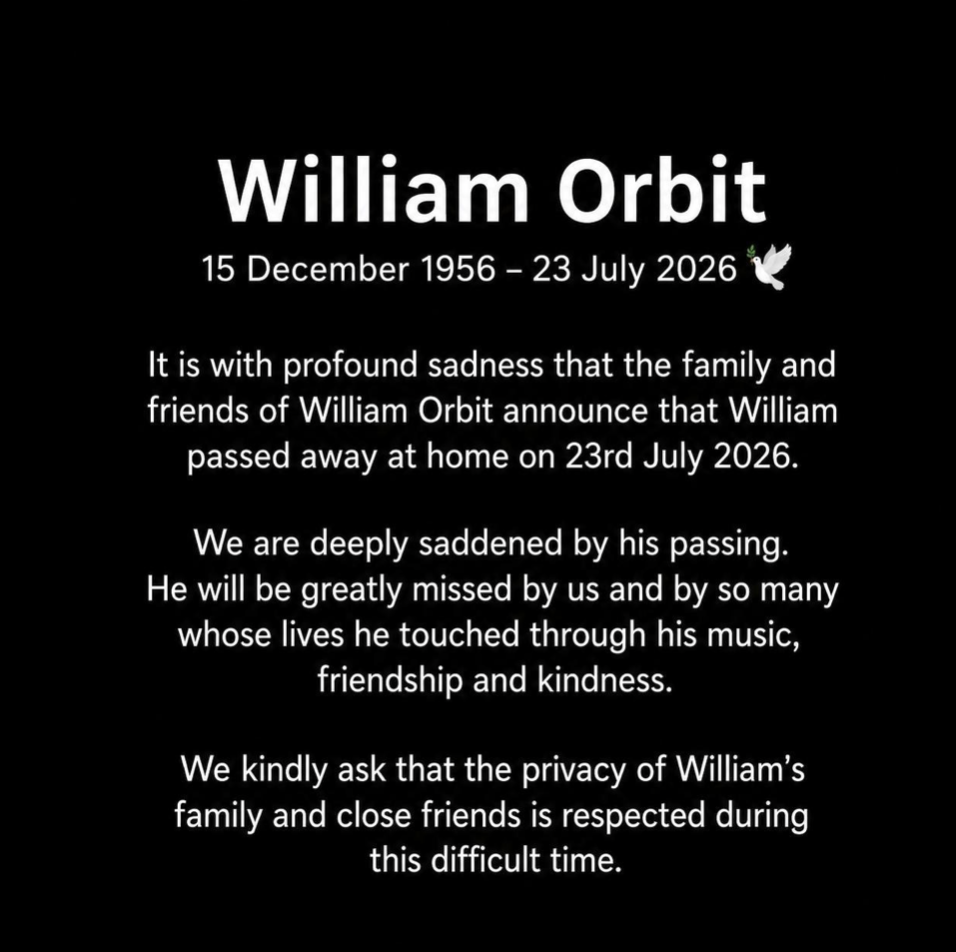
Madonna:
Madonna shared emotional tributes and historic clips from their 1999 Grammy wins, remembering Orbit as a creative soul who helped transform her artistry during a pivotal moment in her career.
Nicole Appleton (All Saints):
“We were fortunate enough to work with him on many occasions and on many songs. In the studio, he made me feel so confident, comfortable and always brought the best out in me. He was a treasure in the music industry and we had the most amazing times in the studio and socially. We will forever celebrate him as a music icon.”
Melanie C (Spice Girls):
“Such an honour to have worked with this great man… Sending all my love.”
Skin (Skunk Anansie):
“Been dancing to his music for literally decades, thank you for all the great music we shall have forever.”
Sister Bliss (Faithless):
“Genius and pioneer… wouldn’t have a life in music without him.”
Georgia (Electro-pop artist):
“It was an honour to work with William, I will cherish it forever, long may he live with the electronic acid sounds in the sky.”
The Enduring Afterglow
William Orbit’s legacy is measured not only by the 200 million recordings sold worldwide, but by the quiet spaces he built inside giant pop melodies. He proved that synthesised sounds could carry human warmth, vulnerability, and spiritual resonance.
As we listen back to the shimmering synth pads of “Pure Shores”, the sweeping emotional gravity of Ray of Light, or the serene ambient textures of Strange Cargo, William Orbit’s unique frequencies will continue to echo across the airwaves for generations to come. Rest in peace, William Orbit.


Leave a Reply